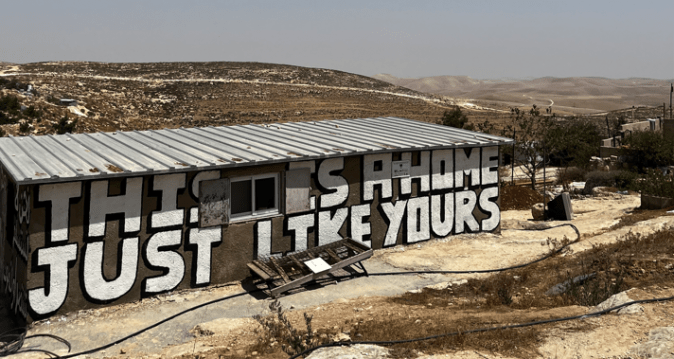
EU-washing Israel’s Greenwash
Note: Due to tight security screening in Israel’s Ben Gurion Airport which includes monitoring of online activity, this piece was written from the West Bank but published after my arrival back in Belgium.
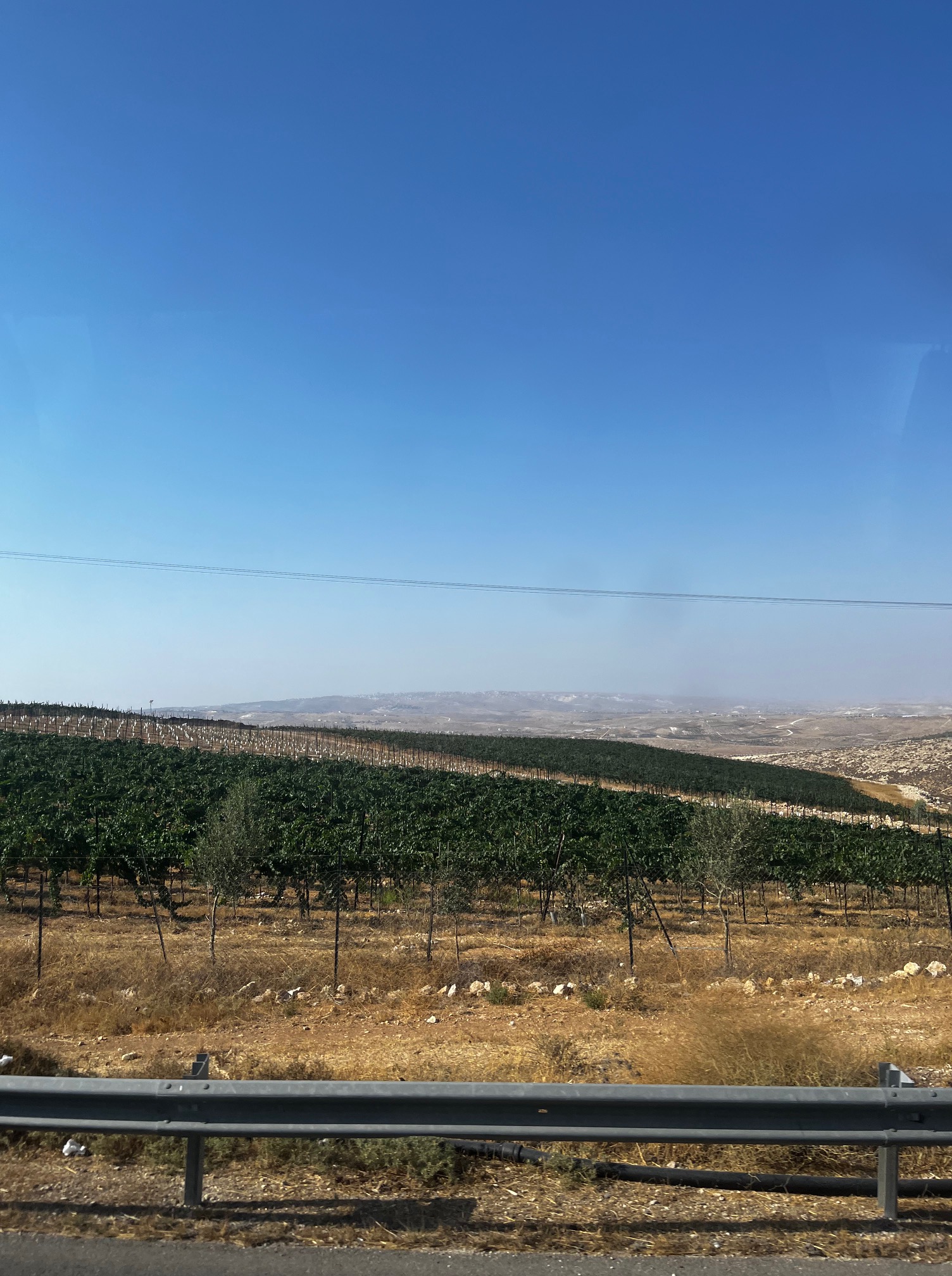
Driving past illegal settlements and their expanding agricultural lands in Palestine’s southern West Bank, the place is certainly blooming into life. But something is off.
In the middle of Palestinian August, rows of grape vines appear in sharp contrast to the sandy soil of the South Hebron Hills. Industrial-size cattle sheds sit in the middle of a rocky outcrop which seems to have been clearcut of all vegetation and tree cover. Plantations are packed with rows of single crops not unlike a roadside scene from the south of France. A farmer with an assault rifle slung over his shoulder sprays his vine leaves. Up the road an Israeli soldier who cannot be any older than 22 sits at the entrance to the vineyard, gun pointed at the windscreen of every passing car on the motorway.
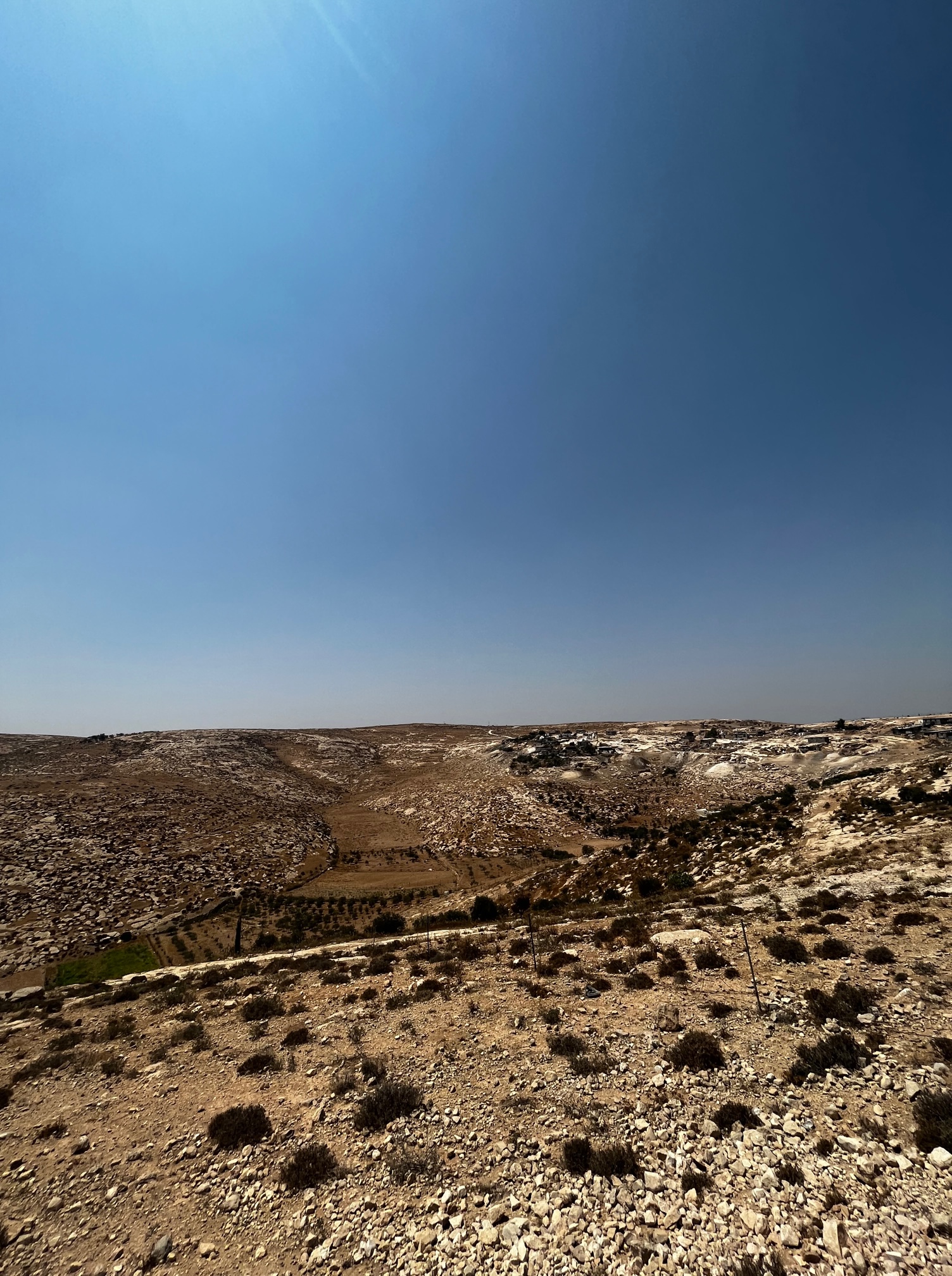
The next town we pass is Palestinian. You can tell because water tanks sit atop every building unlike the previous town. Palestinian access to water mains is severely limited, especially when compared to Israeli settlements, so families tend to collect as much as they can when the pumps are running or when rain comes in winter. The agriculture here also gives a clue to the identity of its residents. Olive groves surround the town. Underneath each tree grow green and yellow rows summer squash. Goatherds from nearby graze their flock between the crops, fertilising and weeding at the same time.
The contrast between these two towns made me think back to a speech made in Brussels earlier this year.
EU-Washing Israel’s Greenwash
In her address marking 75 years since the foundation of Israel in April of this year, President of the European Commission Ursula von der Leyen praised the small Middle Eastern country for having “made the desert bloom.” For those of us who follow developments in the region closely, this statement left jaws on the floor. A friend who works closely on Irish-Israeli relations told me at first she thought the video was a deep-fake or had been manipulated.
The phrase is a copy and paste of Israeli propaganda dating back to the Presidency of Levi Eshkol in the 1960s at the latest. Ursula von der Leyen’s speechwriter had apparently cobbed his or her notes from the Israeli foreign ministry directly. The phrase is problematic for positing two false conclusions: that the land of Mandatory Palestine prior to the foundation of Israel was more or less empty; and that since then the Israeli state has overseen some form of agricultural miracle.
No mention in the President’s speech was made of the occupation of the Palestinian Territories. No reference to the large-scale and illegal annexation of the West Bank. Not a word about the massive demonstration in Tel Aviv against Netanyahu’s attempts to reign in the country’s judiciary.
In a rare strongly-worded statement, the Palestinian foreign ministry called President von der Leyen’s suggestion an “anti-Palestinian racist trope”.
Amongst the tiresome tropes of ‘two-state solutions’, ‘right to defend itself’, and ‘settlements as an obstacle to peace,’ as far as I can tell, there has been little to no change in the language used to discuss the situation between Israel and Palestine since the second Intifada in the early 2000s.
It is portrayed as a ‘conflict’ as if both sides are on equal footing. No reference is made to international relations’ worst-kept secret of the Israeli nuclear arsenal. No sentence notes the vastly different situation on the ground in the West Bank and Gaza since the Oslo Accords were reached in the late 1990s.
Von der Leyen is far from unique in her regurgitating of myths around the achievements of the Israeli occupation. It surprised no one that the President didn’t make reference to the fact that Palestinians refer to the foundation date of Israel as the ‘Nakbah’ – the Catastrophe.
One thing has changed however in recent discourse on the issue – climate change and environmentalism has entered the frame. And President von der Leyen, as the guardian of the European Green Deal and EU climate action, here once again lends environmental kudos to Israel for their nation-building project at the expense of an occupied people.
Green Parties take the bait
In an internal debate amongst European Green party politicians earlier this year, it was fascinating to hear even progressive and green politicians parrot the speaking points of the Israel Ministry for Foreign Affairs when it comes to their record on the environment and climate action. It was a reminder that support for Israeli apartheid is not only the preserve of the European right wing usual suspects like Hungary’s Viktor Orban or Poland’s Andrzej Duda.
Just this summer the German Delegation of the Greens/EFA group in the European Parliament voted with the far-right in criticism of the Palestinian Authority and Palestinians themselves. Amendments from far-right and fascist elements of the European Parliament marched out sad clichés about Palestinian ‘terrorism’ vs Israeli ‘self-defense’ and certain politicians from across the political spectrum fell into line behind them. Certain Green MEPs broke from their Group and aligned themselves with the far right in attacking the barely-functioning Palestinian government.
In Berlin, leaders of almost every party stick to tired language emphasising Israel’s ‘right to defend itself’ and condemning Palestinians to simply wait for the generosity of Tel Aviv to improve the situation. Statements from Annalena Baerbock, Germany’s Green Foreign Minister refer to Palestinian ‘terror attacks’ but deadly Israeli raids on refugee camps as ‘military operations’.
In Austria, the Green party voted to condemn efforts to boycott Israeli products in a resolution that conflated any criticism of the government in Tel Aviv with antisemitism. The right-wing Austrian People’s Party, which often rails against ‘cancel culture’, is known to kick out members for as little as posting a Palestinian flag on social media.
This is not to say of course that Green movements and parties are responsible for the greenwashing of Israel. The prime actors behind that particular strain of propaganda has always been the right and far-right, who use support for Israel as a method of laundering Islamophobia and anti-Arab racism in a way that is palatable to a wider audience.
However several examples show that certain progressives and Greens are willing at least to be complicit or silent on the issue. As Tel Aviv introduces more illiberal reforms, passes laws deliberately discriminating against Palestinians and even posits reintroducing the death penalty (for Palestinians only) these political movements should be wary that they risk not just taking sides in the Palestine-Israel debate, but they could be taking the wrong side in wider discussions on democracy vs autocracy in the Jewish State.
At the outset of the international climate conference COP27, Palestinian Human Rights group Al-Haq goes as far to describe the situation on the ground as ‘climate apartheid’.
“The delegation weaponised Israel’s long-used greenwashing strategy, boasting about the country’s “leading role” in climate tech and innovation toward climate change mitigation and adaptation, in areas such as renewable energy, gas, water desalination and reuse, afforestation, and alternative proteins.”
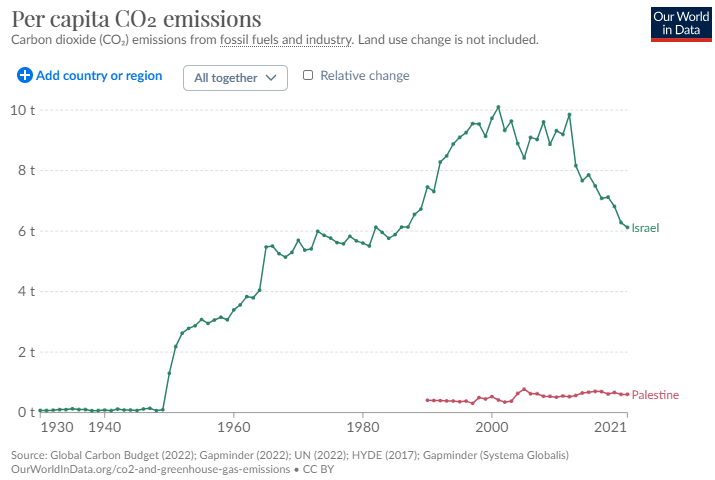
Environmental Programmes and their counterparts
It doesn’t take much research to find the holes in the logic upholding Israel as an environmental champion. In the Negev desert (Naqab in Arabic) the Jewish National Fund, the primary NGO for the purchase and development of land in the region, has led an afforestation campaign that may seem heroic on the face of it as the world cries out for immediate climate action. The JNF claims to have planted over 250 million trees in total. Similar to the culture of plantation agriculture introduced by Israeli settlers across the West Bank however, the JNF has been accused of a massive campaign of planting non-native pine trees where before stood century-old olive trees, acacia and cedars. The result is a smattering of strangely familiar forests to Europeans but against a Middle Eastern backdrop. Bedouin communities have seen their olive groves uprooted to make ways for European style monoculture pine plantations. Outside Jerusalem, the JNF’s plantations disguise the ruins of ‘depopulated’ pre-1948 Palestinian villages.
Mine is of course a somewhat biased view of the agricultural cleavages in the region. Palestinian agricultural methods are also becoming more focused on cash crops and traditional farming methods are fading into memory. In an interview with Palestinian agronomist Saad Dagher, he notes that the agricultural biodiversity of Palestinian farms has dropped ‘significantly’. However, the body of research here holds up the fact that Israeli settlement and annexation has imported the same unsustainable agricultural models from Europe and the US that have multiplied water and pesticide use, aiding the collapse of insect and plant biodiversity in those continents over the last centuries.
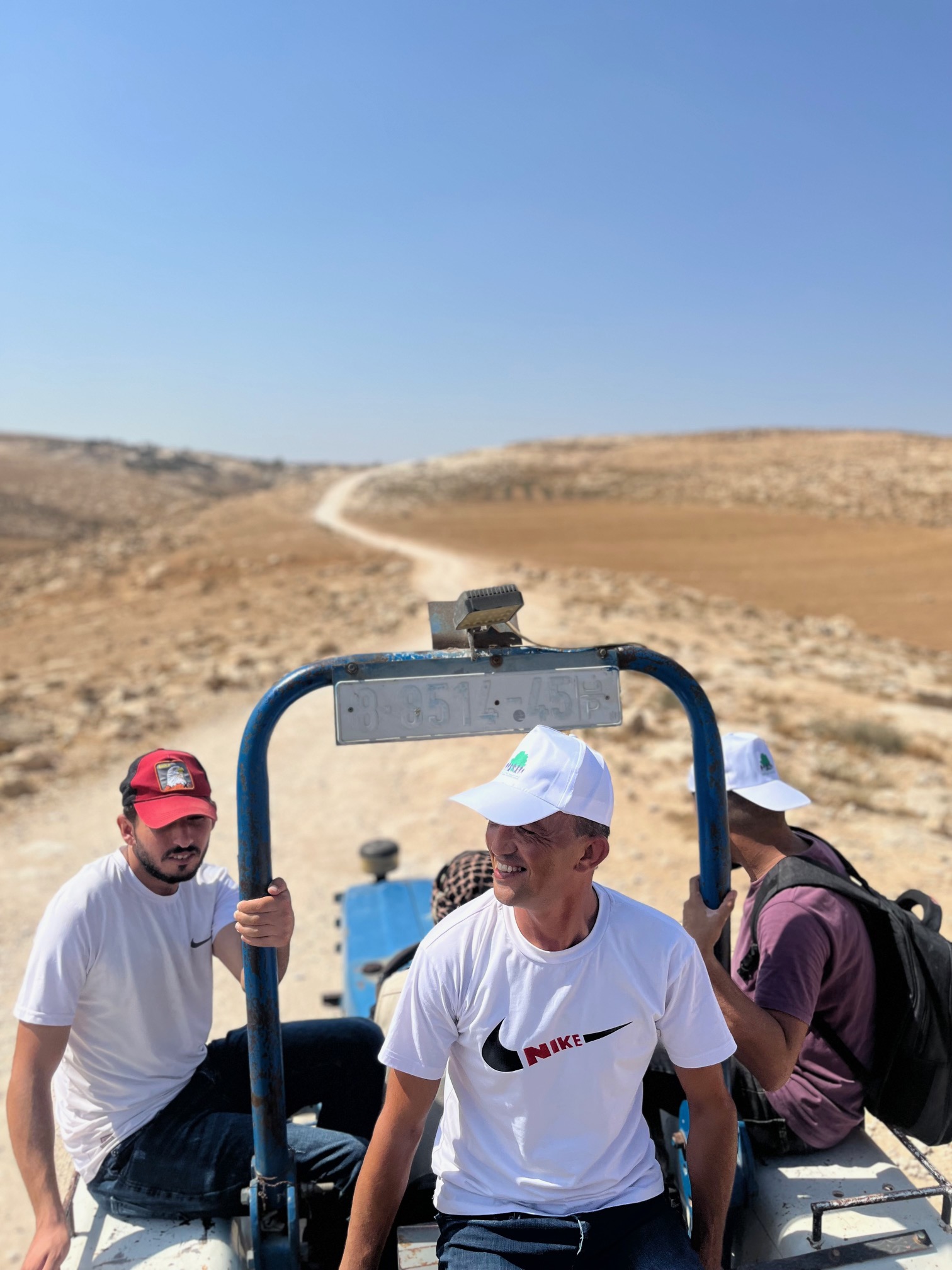
Mahmoud Zwahre works with the Popular Struggle Coordination Committee (PSCC), an organisation that coordinates non-violent resistance in Palestinian villages threatened by settlements and the Israeli wall. On our way to Masafer Yatta, a Palestinian-populated area that has been classified as a ‘Military Firing Zone’ by the Israeli occupation, Mahmoud points to the lines of tall European cypress trees on the horizon. “We used to plant cactus there as fences,” he notes, “now there are only imported cypress and plantations. The cactus was much better for the soil.”

Water use is a key issue here. Studies show that 70% of Israeli settler land is irrigated, compared to just 6% of Palestinian land. As a result, settlements also have an increased output of sewage and wastewater. In a 2015 study by the UN Conference on Trade and Development on the ‘Besieged Palestinian Agricultural Sector’ the impacts of Israeli settlements on the Palestinian environment is outlined clearly:
“In 2009, almost 40 per cent of all sewage produced in the West Bank, including East Jerusalem, originated from Israeli settlements, many of which disposed of raw sewage directly into the surrounding environment. Today, Israeli settlements release approximately 35 mcm of untreated sewage each year into the surrounding environment. This undermines Palestinian agricultural land, polluting water sources and endangering the health of entire communities.”
The overall picture is one where Israel’s impact on the environment on both sides of the Separation Barrier wall is damaging, invasive, intensive and simply unsustainable in the most basic sense of the word. Plantations and agricultural settlements are swiftly replacing traditional Palestinian farming methods and Bedouin pastoral communities. Crops that are normally sold in local towns and villages are now substituted with cash crops for export like wine grapes or beef.
So in a way President von der Leyen is right. Israel is making the ‘desert’ bloom. It is blooming with the same plantation agriculture that has decimated European soil quality and polluted our rivers, all built on illegally annexed land and irrigated with inequality. It comes to the detriment of people and planet and leaves nothing but death in its wake. In this way, Israel’s plantation of the West Bank manifests itself more like an algal bloom.
 The Border Reiver